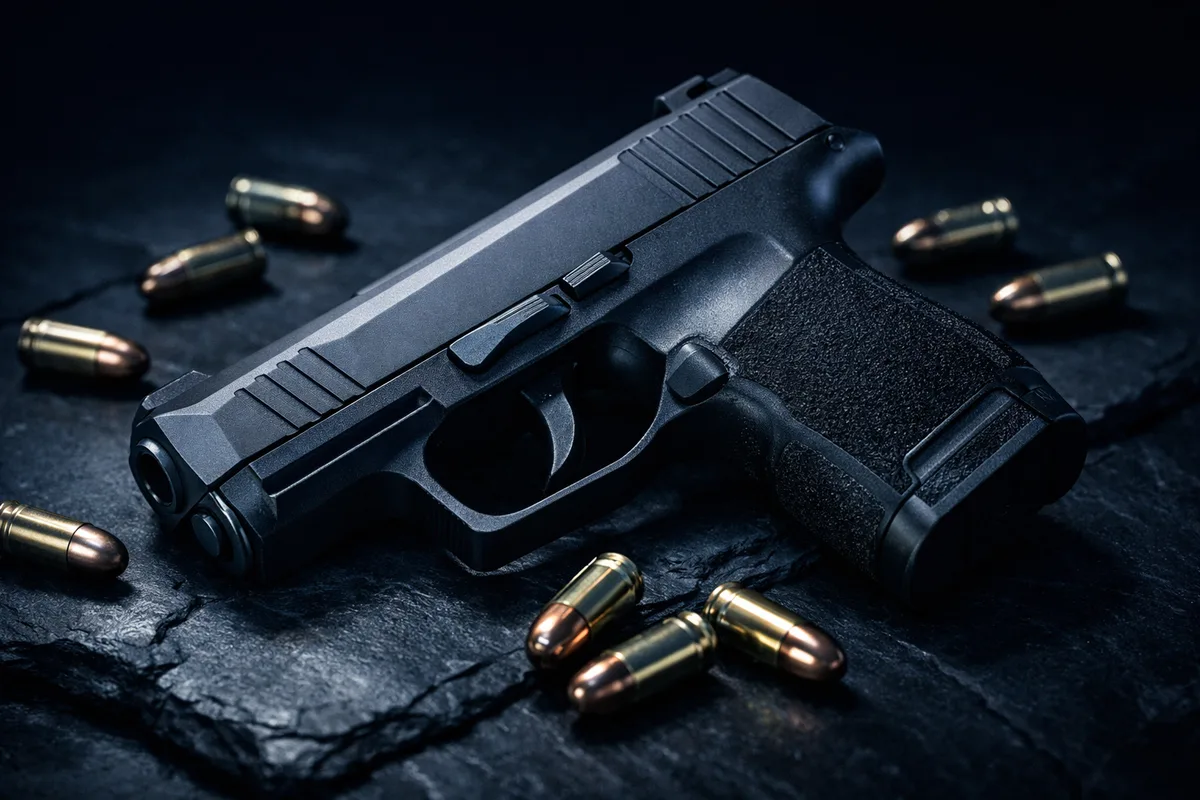
What You'll Learn
- How FMJ and JHP bullets work — with the physics explained simply
- The overpenetration gap: FMJ goes 25-30+ inches in gel, JHP stays under 19"
- Gel test data comparing the top 5 defensive JHP loads
- The 30-second rule: FMJ for range, JHP for defense (with one exception)
- Legal restrictions on hollow points (looking at you, New Jersey)
FMJ or hollow point? It's one of the first questions every new gun owner asks — and the answer is simpler than most guides make it.
FMJ for range, JHP for defense. That's the 30-second version. But the "why" behind that rule involves some fascinating physics and important data that every gun owner should understand.
How FMJ Works
A Full Metal Jacket bullet is a lead core completely encased in a harder metal (usually copper). The tip is smooth and rounded. When it hits a target, it doesn't expand — it punches straight through, retaining its shape.
This is great for range practice: FMJ makes clean holes in paper, feeds reliably in any gun, and costs $0.17–0.22/rd instead of $0.85–1.50/rd for JHP. It's also easy to manufacture, which is why it's the cheapest option.
This is terrible for self defense: FMJ overpenetrates massively. In ballistic gel, 9mm FMJ penetrates 25–30+ inches — far exceeding the FBI's 18-inch maximum. That bullet will pass through an attacker, through a wall, and potentially hit someone behind them.
How Hollow Point (JHP) Works
A Jacketed Hollow Point has a cavity in the tip. On impact, hydraulic pressure from tissue or gel forces the bullet to "mushroom" — expanding to 1.5–2x its original diameter. This expansion does two critical things:
- Creates a larger wound channel — transferring energy more effectively to the target
- Slows the bullet down — stopping it within 12–18 inches instead of 25–30+ inches, reducing the risk of hitting bystanders
Quality JHP ammo stays within the FBI's recommended 12–18 inch penetration window. That's deep enough to reach vital structures from any angle, but not so deep that it exits the body.
Gel Test Data: The Numbers
This data comes from Lucky Gunner Labs testing through 4-layer denim (simulating clothing) from compact pistol barrel lengths:
| Load | Type | Penetration | Expansion | Key Trait |
|---|---|---|---|---|
| 9mm FMJ 115gr | FMJ | 25–30+" | None (0.355") | Massive overpenetration |
| Federal HST 147gr | JHP | 15.24" | 0.606" (71%) | Best centered in FBI window |
| Federal HST 124gr | JHP | 18.28" | 0.606" | Most adopted LE load |
| Speer Gold Dot 124gr | JHP | 18.14" | 0.538" | Near 100% weight retention |
| Hornady Crit. Defense 115gr | JHP | 13.06" | 0.504" | Best for micro-compacts |
| Hornady Crit. Duty 135gr +P | JHP | 18.08" | 0.468" | Passes all FBI barrier tests |
The difference is stark: FMJ penetrates almost twice as deep as even the deepest-penetrating JHP. And it creates a wound channel no wider than the bullet itself (0.355 inches) versus 0.5–0.6+ inches for JHP.
When to Use Each
Use FMJ for:
- Range practice and training
- Competition shooting (where expansion doesn't matter)
- Breaking in a new gun (run 200+ FMJ rounds to verify function)
Use JHP for:
- Concealed carry
- Home defense
- Any situation where you need to stop a threat AND minimize the risk to bystanders
The exception: Frangible ammo
Some indoor ranges require frangible ammunition — bullets made of compressed copper or metal powder that break apart on contact with hard surfaces. This prevents ricochets off steel backstops. Frangible ammo is NOT suitable for self defense (insufficient penetration).
Legal Restrictions on Hollow Points
New Jersey effectively bans hollow point ammunition for carry. You can possess JHP at home and transport it to/from the range, but carrying it in public requires a specific exemption. NJ is the only state with this restriction — all other states allow JHP for self defense.
If you're in New Jersey, carry FMJ or use Hornady Critical Defense — some NJ attorneys argue the polymer-filled tip means it isn't technically a "hollow point." Consult a NJ firearms attorney for current guidance.
Cost Comparison
At March 2026 pricing:
| Type | Cost Per Round | 1,000 Round Cost | Use |
|---|---|---|---|
| 9mm FMJ (bulk) | $0.22 | ~$220 | Range only |
| 9mm JHP (defensive) | $0.85–1.50 | N/A (buy 40-100 rounds) | Carry/HD only |
You don't buy 1,000 rounds of JHP. You buy 2-4 boxes (40-100 rounds) — enough to function-test in your gun and load your carry magazines. The rest of your shooting budget goes to FMJ range ammo.
Frequently Asked Questions
Is FMJ or hollow point better for home defense?
Hollow point (JHP), always. FMJ overpenetrates — a 9mm FMJ round can pass through an attacker, through interior walls, and into adjacent rooms. JHP expands on impact, stopping within 12-18 inches. This reduces the risk to family members in other rooms.
Can I use FMJ for self defense in an emergency?
If it's all you have, it's better than nothing. FMJ will absolutely stop a threat — it just carries a higher risk of overpenetration. If you carry a firearm, invest $20-30 in a box of quality JHP for your carry magazine.
Are hollow points legal everywhere?
Yes, except New Jersey, which effectively bans hollow points for concealed carry (you can possess them at home and transport to/from the range). All other US states allow JHP for self defense.
Why is JHP so much more expensive than FMJ?
JHP bullets are more complex to manufacture. The hollow cavity must be precisely formed, the jacket must be scored or engineered to expand consistently, and quality control standards are much higher. You're paying for engineering and reliability — which is worth it for ammo you might need to save your life.
What about JSP (Jacketed Soft Point)?
JSP is a middle ground — a partially exposed lead tip that expands less than JHP but more than FMJ. It's primarily used for hunting where deep penetration with moderate expansion is ideal. For self defense, JHP is better. For range use, FMJ is cheaper.
Related Posts
Don't Miss the Next Price Drop
Weekly deal roundups, price alerts, and market analysis — delivered to your inbox.
No spam. Unsubscribe anytime.
You're in!