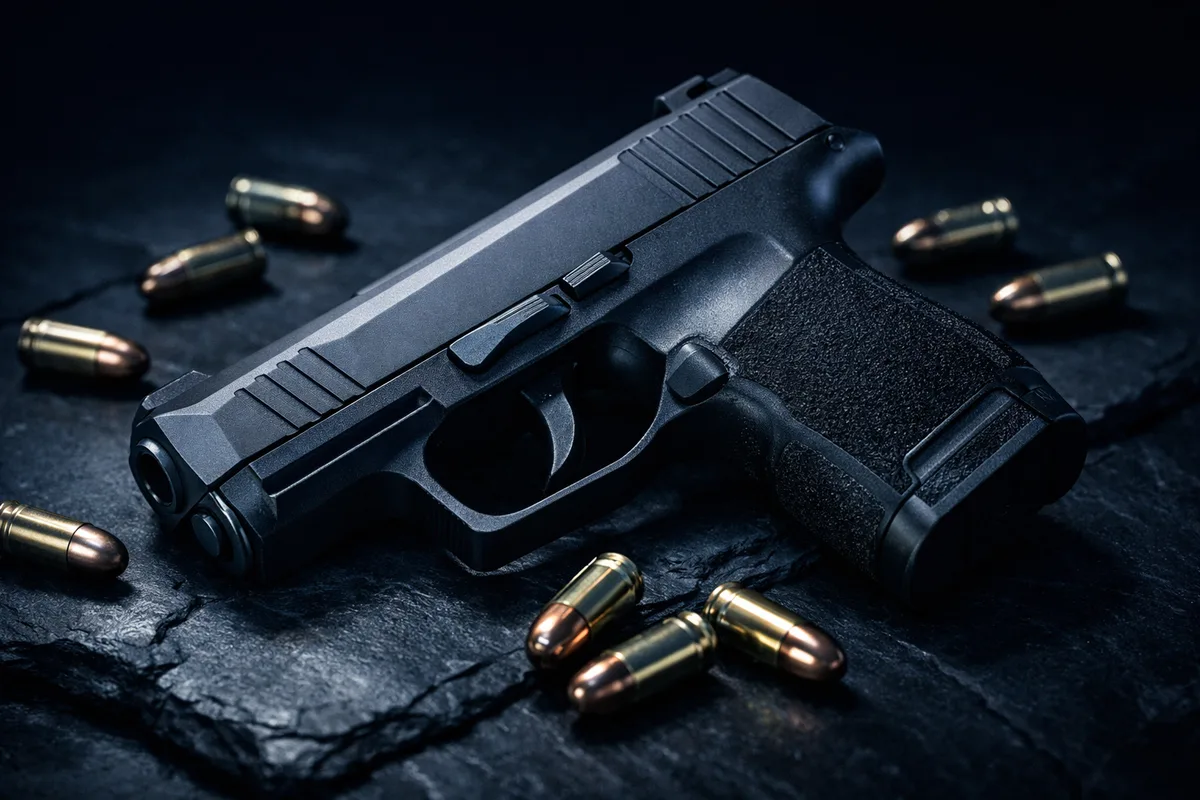
What You'll Learn
- How to figure out what caliber your gun shoots (it's stamped on the barrel)
- FMJ vs hollow point vs frangible — which to buy and when
- What "grain" means (hint: it's bullet weight, not powder)
- What +P means and whether your gun can handle it
- How to buy ammo online — and which states restrict it
- How much to buy for your first purchase
You just bought your first gun. Now you're staring at an ammo wall (or a website) with hundreds of options and no idea what to grab. Every box has numbers and abbreviations that mean nothing to you. 9mm, .45 ACP, 124gr, FMJ, JHP, +P — it looks like a foreign language.
This guide translates all of it into plain English. By the end, you'll know exactly what to buy, how much, and where to get it at the best price.
Step 1: Find Your Caliber
Your gun's caliber is stamped on the barrel or slide. Look for markings like "9mm," ".45 ACP," ".380 AUTO," "5.56 NATO," or ".22 LR." This tells you what ammo to buy. If you can't find it, check the owner's manual or look up your gun's model number online.
Never guess your caliber. Loading the wrong ammunition can cause a catastrophic failure — a destroyed gun and potentially serious injury. If you're unsure, take your gun to a local gun store and ask. They'll tell you in 10 seconds.
Here are the most common calibers and what they're typically found in:
| Caliber | Common Guns | Typical Use | Approx. Cost/Round |
|---|---|---|---|
| 9mm / 9x19 / 9mm Luger | Most modern handguns | Carry, home defense, range | $0.22 |
| .45 ACP | 1911s, Glock 21, USP | Carry, home defense | $0.42 |
| .380 ACP / .380 Auto | Small pocket pistols | Concealed carry | $0.35 |
| 5.56/.223 | AR-15 rifles | Range, home defense, hunting | $0.44 |
| .22 LR | Ruger 10/22, many pistols | Plinking, training, small game | $0.06 |
| 12 Gauge | Pump/semi-auto shotguns | Home defense, hunting, clays | $0.30 |
| .308 Win / 7.62 NATO | Bolt-action, AR-10 | Hunting, long-range | $0.80 |
Note: "9mm," "9x19," and "9mm Luger" are all the same cartridge. Same with ".45 ACP" and ".45 Auto." And ".380 ACP" and ".380 Auto." Gun manufacturers and ammo companies use these names interchangeably.
Step 2: Understand Bullet Types
FMJ — Full Metal Jacket (Range / Practice)
What it is: A lead bullet completely encased in a copper jacket. The tip is rounded and smooth. This is the cheapest and most common type of ammo.
When to use it: Range practice, training, plinking. FMJ is designed to punch clean holes in paper targets. It does NOT expand on impact, which means it overpenetrates — it'll go straight through a target and keep going. That's fine at the range, bad for home defense.
JHP — Jacketed Hollow Point (Self Defense)
What it is: A bullet with a hollow cavity in the tip designed to expand (mushroom) on impact. This expansion creates a larger wound channel and — critically — causes the bullet to slow down and stop inside the target instead of passing through.
When to use it: Concealed carry, home defense, any situation where stopping an attacker and minimizing overpenetration matters. Quality JHP ammo costs $0.85–$1.50/rd versus $0.20–0.30/rd for FMJ. You don't shoot it at the range — you carry it.
Frangible (Indoor Range / Special Use)
What it is: A bullet made of compressed copper or metal powder that breaks apart on impact with hard surfaces. Designed to minimize ricochet at steel targets and indoor ranges.
When to use it: Some indoor ranges require frangible ammo. It's also used for close-quarters training. Not recommended for self-defense — it doesn't penetrate deeply enough.
The 30-second rule: FMJ for range, JHP for defense. That's it. If you remember nothing else from this guide, remember that.
Step 3: What "Grain" Means
A grain (gr) is a unit of weight equal to 1/7,000th of a pound. In ammunition, it measures the bullet's weight — not the powder charge.
The same caliber comes in different grain weights. For example, 9mm comes in 115gr, 124gr, and 147gr. Here's what that means in practice:
- Lighter bullets (115gr 9mm): Faster velocity, slightly more "snappy" recoil, cheapest option. Great for range practice.
- Medium bullets (124gr 9mm): The all-around sweet spot. Most defensive ammo is 124gr. Balanced velocity and penetration.
- Heavier bullets (147gr 9mm): Slower velocity, softer "pushing" recoil. Subsonic (quieter with a suppressor). Best from 4"+ barrels.
For your first purchase, don't overthink grain weight. 115gr FMJ for range, 124gr JHP for carry. Read our 9mm grain weight deep dive when you want the full picture.
Step 4: What Does +P Mean?
+P means the ammunition is loaded to a higher pressure than standard — 38,500 PSI versus 35,000 PSI for 9mm. Higher pressure means higher velocity (50–100 fps more), which translates to roughly 10–15% more energy.
Can your gun shoot +P? Check your owner's manual. Most modern handguns from SIG, Glock, S&W, Springfield, and Ruger are rated for +P. Older or budget guns may not be. If the manual doesn't mention +P, assume your gun is NOT rated for it.
What about +P+? There is no SAAMI specification for +P+. Each manufacturer sets their own pressure limits. Use +P+ only if your gun's manufacturer explicitly approves it.
Step 5: Buying Ammo Online
Is it legal? Yes, in most states. You must be 18 to buy rifle/shotgun ammo and 21 to buy handgun ammo. Ammo ships via UPS/FedEx ground (hazmat designation) to your door — no FFL (gun dealer) transfer needed in most states.
State restrictions: Some states limit or ban online ammo purchases. California requires purchase through a licensed vendor with a background check. New York requires shipping to an FFL. New Jersey, Connecticut, Massachusetts, and Illinois have additional requirements. Always verify your state's current laws before ordering.
How to get the best price: Buy in bulk. A 50-round box at the local gun store might cost $0.40/rd. A 1,000-round case online costs $0.22/rd. That's a 45% savings. Many retailers offer free shipping on orders over $100–200.
Step 6: Your First Ammo Purchase
Here's exactly what to buy as a new gun owner with a 9mm handgun:
- 200–500 rounds of 115gr FMJ for range practice (Blazer Brass, Federal American Eagle, or Winchester White Box)
- 2 boxes (40 rounds) of 124gr JHP for defensive use (Federal HST, Speer Gold Dot, or Hornady Critical Defense)
Run those 40 rounds of defensive ammo through your gun first — you need to confirm it feeds reliably in your specific firearm. If it cycles without a single malfunction, load your carry magazines with the remaining rounds. If you get jams, try a different brand.
Then shoot your FMJ at the range to build proficiency. Once you're comfortable, buy FMJ in 1,000-round cases for the best per-round pricing.
Frequently Asked Questions
What ammo does my gun use?
Check the barrel or slide — the caliber is stamped on the metal. Common markings include "9mm," ".45 ACP," "5.56 NATO," ".22 LR," etc. If you can't find it, check your owner's manual or take the gun to a local gun store.
Can I use FMJ for self defense?
Technically yes, but you shouldn't. FMJ doesn't expand — it'll pass through an attacker and potentially hit someone behind them. FMJ penetrates 25-30+ inches in gel, far exceeding the FBI's 18-inch maximum. Use JHP (hollow point) for self defense.
How much ammo should I keep on hand?
For a carry gun, keep 2-3 loaded magazines of defensive JHP ammo ready. For range practice, buy 500-1,000 rounds of FMJ at a time — you'll use it faster than you think. .22 LR stores for decades, so buy in bulk when it's cheap.
Does ammo expire?
Not really. Modern ammunition stored in a cool, dry place will last 50+ years. Heat and humidity are the enemies — they degrade the primer and powder over time. Keep your ammo in ammo cans or sealed containers at room temperature.
What's the cheapest way to buy ammo?
Buy online in bulk. A 1,000-round case of 9mm FMJ costs ~$220 ($0.22/rd) versus $18-20 for a 50-round box at a local store ($0.36-0.40/rd). Look for free shipping thresholds — most retailers ship free above $100-200.
Is it legal to buy ammo online?
Yes in most states. You must be 18 for rifle/shotgun ammo, 21 for handgun ammo. California, New York, New Jersey, Connecticut, Massachusetts, and Illinois have additional restrictions. Always verify your state's current laws.
Related Posts
Don't Miss the Next Price Drop
Weekly deal roundups, price alerts, and market analysis — delivered to your inbox.
No spam. Unsubscribe anytime. We never share your email.
You're in!